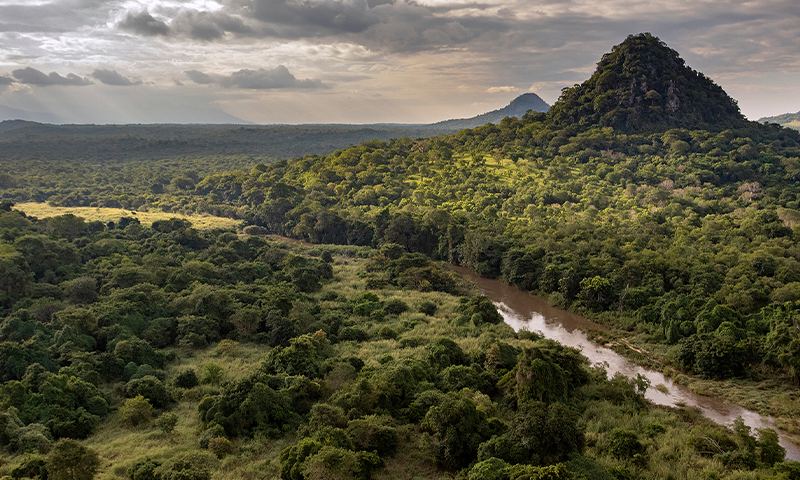
Most restoration stories in Africa are measured in decades and disappointments. Gorongosa's is measured in decades and an ocean of wildlife — Greg Carr's own words for what now moves across plains where, twenty years ago, he could drive for hours with local friends and count himself lucky to see a single warthog. Understanding what happened here, and who made it happen, changes the way the park's luxury camps feel once you're actually standing in them.
What War Actually Took
Between the 1960s and 1990s, Mozambique's independence struggle and subsequent civil war killed an estimated one million people and devastated Gorongosa National Park, once considered one of the finest wildlife sanctuaries on the continent. Soldiers on both sides hunted the park's animals for food and ivory; by the war's end, roughly 95% of its large mammals were gone. What remained of the ecosystem was riddled with an estimated 20,000 snares and wire traps, left behind by a generation that had learned to survive on whatever the bush still offered.
The Idaho Entrepreneur Who Said Yes
Gregory Carr made his fortune in voicemail technology and telecommunications before walking away from the corporate world entirely in 1998 to focus on philanthropy. Africa was not new to him — he had co-founded one of the continent's first internet service providers in the 1990s — but Gorongosa was. Invited by the Mozambican government in 2004, he flew over the park and, in his own account, saw past the emptiness to the rivers, forests and grasslands still intact beneath it.
In 2008, after four years of groundwork, the Carr Foundation signed a 20-year contract with the Government of Mozambique — a public-private partnership built on patience rather than a single grand gesture. Carr has since committed more than $100 million of his own money to the project, and the results speak for themselves: rangers have cleared thousands of snares, reintroduced species locally extinct in the park, and watched predator and prey numbers climb back toward something resembling their former abundance.
"When I first came here in 2004, I could drive around all day and maybe spot one baboon. Now it's an ocean of wildlife." — Greg Carr
Restoration Isn't Just About Animals
What sets the Gorongosa Restoration Project apart from most conservation efforts is its refusal to treat wildlife and human welfare as separate problems. The park now employs around 1,600 people, most of them from surrounding communities. It runs education programmes across 89 primary schools ringing the park's boundary, training hundreds of teachers in a region where generations of conflict had left schooling in ruins. Mount Gorongosa, added to the park's protected area, has seen more than three million trees replanted. An international research station, built in partnership with Carr's friend, the biologist E.O. Wilson, now studies the ecosystem's recovery in real time.
It is, by any measure, one of the most closely watched examples of Gorongosa eco tourism done properly — tourism as the funding mechanism for restoration, rather than restoration dressed up to attract tourists.
Where to Actually Stay
Muzimu Lodge, the park's flagship camp, sits along a bend of the Mussicadzi River — six East African-style tents named for the Shona word for "guardian spirit," each with its own private deck over the floodplain. Further into the park, Chicari Camp takes a wilder approach: ten tents facing a waterhole, including elevated treehide rooms built for guests who would rather watch the bush come to them. Between the two, most of what Gorongosa's recovery actually looks like — elephant herds rebuilding their old migratory habits, lion prides re-establishing territory, a birdlife list that keeps growing — is visible from a deck chair, coffee in hand, exactly the way conservation should occasionally feel.
This is the Fire leg of our circuit for a reason. Gorongosa burned, in every sense, and rebuilt itself — and fire, fittingly, still shapes these plains, both as an ecological force and as the centre of every evening here. Few places on the continent make a stronger case that destruction is not always the end of a story.